
Hoffman Estates Epoxy Flooring installs commercial epoxy flooring in Hoffman Estates, IL, serving surrounding cities including Barrington, Lake Zurich, Wood Dale, Prospect Heights and Cary. Over 20+ years we have coated offices, event venues, retail spaces, shop floors and back-of-house corridors, and the lesson that carries from one to the next is that the schedule and the slab matter as much as the product.
A commercial floor is rarely allowed to close for long. Office suites turn over between leases, venues work between events, and healthcare and hospitality buildings run around the clock. We build every commercial scope around the hours the building has to stay open, including overnight and weekend windows, and name the closure and reopening time for each phase in writing.
The commercial floor stock around the village leans institutional and event-driven rather than heavy industrial: a village-owned arena, a hospital campus, an office campus converted into a food hall and retail street, and former headquarters sites being redeveloped. Each of those floors brings its own traffic, cleaning methods and deadlines, and the system we specify follows from them.
Office, Retail and Tenant Improvement Floors
Office and retail spaces usually want a clean, attractive floor that takes rolling chairs, carts and steady foot traffic. A decorative epoxy system with a flake or quartz broadcast, or a metallic finish in a lobby, gives that look with a seamless surface that is easy to clean. A polyaspartic topcoat adds scratch and stain resistance and holds its color under daylight from storefront glass.
Tenant turnovers set a hard deadline. The floor often comes up from carpet or tile with adhesive and thinset still on it, so grinding is the first and longest step. We work with property managers and general contractors to fit grinding, coating and curing into the window before fixtures, furniture or the next tenant arrive, and fast-curing systems help when that window is days rather than weeks.
Arena, Hotel and Event Back-of-House Floors
Venue floors work hard in short bursts. Concourses, loading docks, service corridors and kitchens see crowds, carts, spilled drinks and cleaning machines, then sit quiet until the next event. The village’s own arena had a finished epoxy placed over its existing concourse concrete in 2023, the kind of job where the calendar sets the schedule and the floor has to be ready before doors open.
We plan these jobs around the event calendar, staging equipment, grinding and coating in sections between bookings or overnight. Hotels need similar care in service corridors, laundries and kitchens, where we phase work so housekeeping and food service can continue. In every case the proposal lists the exact areas closed in each window and when they reopen to foot traffic and to carts.
Healthcare, Lab and Data Support Spaces
Healthcare campuses, labs and data facilities have support spaces such as mechanical rooms, loading areas, storage rooms and corridors that need durable, cleanable floors. Some of those spaces also need static-dissipative or ESD flooring to protect sensitive electronics, installed and tested to the resistance range the space calls for.
Work in or near occupied healthcare buildings calls for tight dust and odor control. We grind with HEPA extraction, isolate the work area, and choose low-odor, 100% solids or water-based systems within the Illinois VOC limits. Scheduling follows the facility’s infection-control and operations requirements rather than our own preferences.
Light-Industrial and Warehouse Floors
Light-industrial floors, warehouses and distribution spaces take forklift traffic, pallet drops, rolling loads and occasional chemical spills. Those floors need a thicker, high-build epoxy or a urethane system, a deeper surface profile from shot blasting or aggressive grinding, and careful joint work. Joints are where forklift wheels start breaking a slab down, so we fill them with a semi-rigid polyurea that supports the edges.
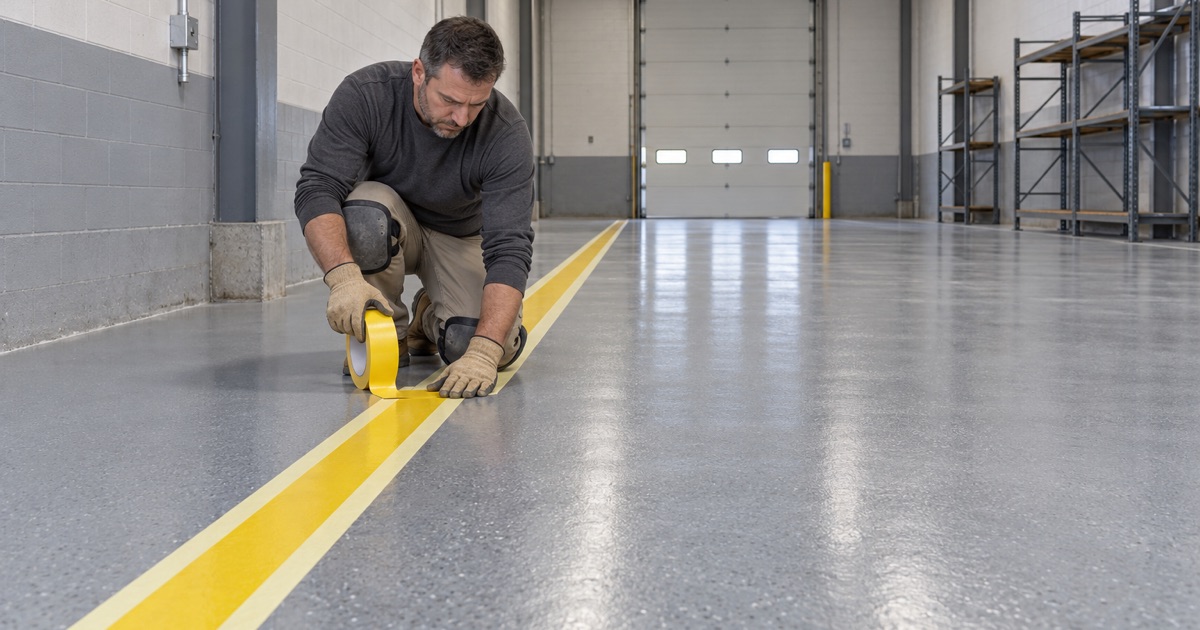
Safety striping, aisle lines and zone colors can be built into the system so they wear with the floor rather than flaking off as paint does. Where a space needs more grip, a quartz broadcast or anti-slip aggregate in the topcoat adds texture without making the floor hard to clean.
Compliance, Registration and VOC Limits
Illinois issues no state license for flooring or coatings work, so contractor rules come from each village. In Hoffman Estates, contractor registration costs $100 a year with a $10,000 surety bond and general liability coverage, and flooring is not a named category, so a coating contractor registers under the general category when a permit is pulled. We confirm the rules in each village and ask the permit desk whether a coating counts as finish work before the job is scheduled.
Floor and industrial maintenance coatings in Illinois are subject to VOC content limits under 35 Ill. Adm. Code Part 223, alongside the national architectural coatings rule in 40 CFR 59 Subpart D. The Illinois limit binds the installer as well as the manufacturer, so we choose compliant products and keep the data sheets on file. Where a floor must meet food code requirements, such as a commercial kitchen, we specify coved bases and cleanable surfaces to match.
Every commercial proposal names the product, the system build and the finished thickness for each area, so a facilities manager or owner’s representative can check what went down against what was bid. We also read the warranty exclusions aloud before the job is awarded, moisture first, because a slab with no vapor retarder beneath it can defeat even a well-installed commercial system, and the moisture test in our scope is how that risk is caught early.
- 20+ Years Coating Concrete
- Moisture Testing in Every Scope
- Written Contract on Every Home Job