
Hoffman Estates Epoxy Flooring installs ESD flooring in Hoffman Estates, IL, serving surrounding cities including Barrington, Lake Zurich, Wood Dale, Prospect Heights and Cary. Static-control floors are a small share of the work we do, but in 20+ years of coating concrete we have seen how much depends on details an ordinary coating job never has to consider: the grounding, the resistance range and the cleaning products used after we leave.
An electrostatic discharge, or ESD, floor is a resin floor built to move static charge from people, carts and equipment safely to ground. Electronics assembly, repair benches, labs, server and data rooms, and some healthcare and manufacturing spaces use them to protect sensitive devices that a static spark too small to feel can damage.
The proposal for an ESD floor names the system, the classification it is built to, the grounding layout and the test method we will use to verify it. That way the facility has a specification it can hold the finished floor to, and readings it can file with its ESD control program.
Conductive and Static-Dissipative Floors
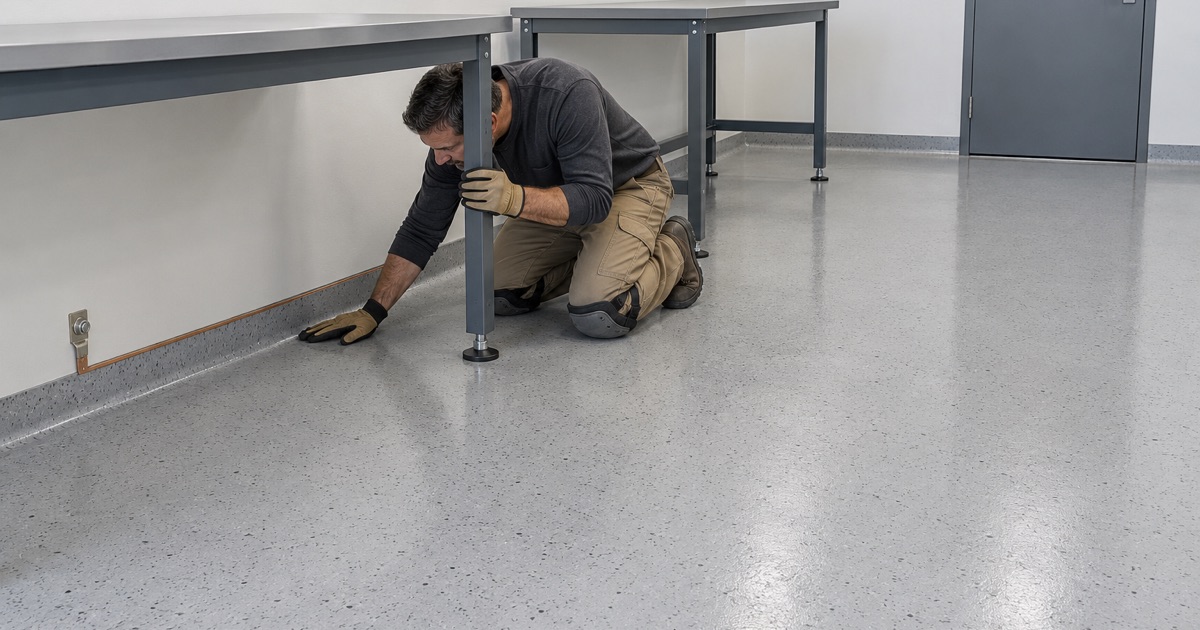
Static-control floors fall into two classes based on electrical resistance. Conductive flooring measures at or below 1.0 x 10^6 ohms and drains charge quickly. Static-dissipative flooring measures above 1.0 x 10^6 and below 1.0 x 10^9 ohms and drains charge more slowly, which some applications prefer because it limits the rate of discharge.
Many contractor sites blur the two together, but they are different products for different uses. The right choice depends on what is handled in the space, the facility’s ESD control plan and the footwear the staff wear. We build to the class the facility specifies rather than picking one by habit, and if a space has no specification yet, we point the owner to the standard so the decision rests with the people responsible for the devices.
What ANSI/ESD S20.20 Asks of a Floor
The ANSI/ESD S20.20 standard, widely used in electronics handling, sets two requirements for a floor and footwear system working together. The resistance from a person, through their footwear and the floor, to ground must be below 1.0 x 10^9 ohms. The body voltage generated while that person walks across the floor must stay below 100 volts peak.
The second requirement is often the harder one to meet, and it depends on the footwear as much as the floor. That is why an ESD floor alone does not make a space compliant. We install and test the floor to its specified resistance, and we tell the facility plainly that its footwear program and periodic testing complete the system.
How an ESD Epoxy Floor Is Built
An ESD floor starts like any other coating: the slab is ground with diamond tooling to the profile the system requires, cracks are repaired and the slab is moisture tested. Moisture matters even more under an ESD floor, because a coating that lifts breaks the conductive path as well as the floor’s appearance.
Next comes a conductive primer or a grid of copper grounding strips laid on the slab, connected to the building’s ground at specified points. The ESD body coat, a resin loaded with conductive fibers or fillers, goes down over the conductive layer and carries charge from the surface down to that grid. Each layer has to be continuous; a gap in the primer or a skipped grounding point leaves a dead zone in the floor that no topcoat can fix.
Testing and Documentation
Once the floor has cured, we measure resistance across the surface and from the surface to ground at multiple points, following the test methods named in the specification. Readings are recorded on a floor plan so the facility can see that every zone falls within range. If any area reads outside it, we find and correct the cause before handing the floor over.
That documentation becomes the baseline for the facility’s own periodic testing. ESD floors change slowly as they wear and as cleaning residues build up, and comparing future readings with the installation baseline is how a facility knows when maintenance or a topcoat refresh is due.
Caring for a Static-Control Floor
Waxes, floor finishes and many general-purpose cleaners leave a thin insulating film that raises a floor’s resistance over time. ESD floors should be cleaned with products approved for static-control surfaces and never waxed or finished with ordinary polish. We provide written cleaning guidance with every ESD floor we install.
Heavy carts, chair casters and dropped tools can wear or damage the surface, so mats, chair glides and repair of damaged areas keep the floor performing. Where a facility expands or rearranges workstations, we can extend the floor and its grounding to match, using the same system so the new area tests consistently with the old.
Scheduling ESD Work in an Operating Facility
Most ESD floors go into buildings that are already running, whether an electronics bench area, a lab suite or a data room alongside live equipment. We phase the work so each zone can be cleared, ground, coated and tested while the rest of the space keeps operating, and we schedule grinding overnight or on weekends where dust or noise would disrupt production. HEPA extraction runs on every grinder, and the work zone is sealed from sensitive equipment.
We also coordinate the grounding connections with the facility’s electrician or maintenance team before the job begins, so the floor ties into the building ground at points that are documented and accessible. Products are chosen within the Illinois VOC limits for floor coatings, and the cure schedule is set against slab temperature so the space returns to service on the date the proposal names.
- 20+ Years Coating Concrete
- Moisture Testing in Every Scope
- Written Contract on Every Home Job