
Hoffman Estates Epoxy Flooring grinds and polishes concrete floors in Hoffman Estates, IL, serving surrounding cities including Barrington, Lake Zurich, Wood Dale, Prospect Heights and Cary. A polished floor is the slab itself, cut open with diamonds and refined until it reflects light, and after 20+ years of grinding concrete for coatings we know how much the slab under your floor decides the result.
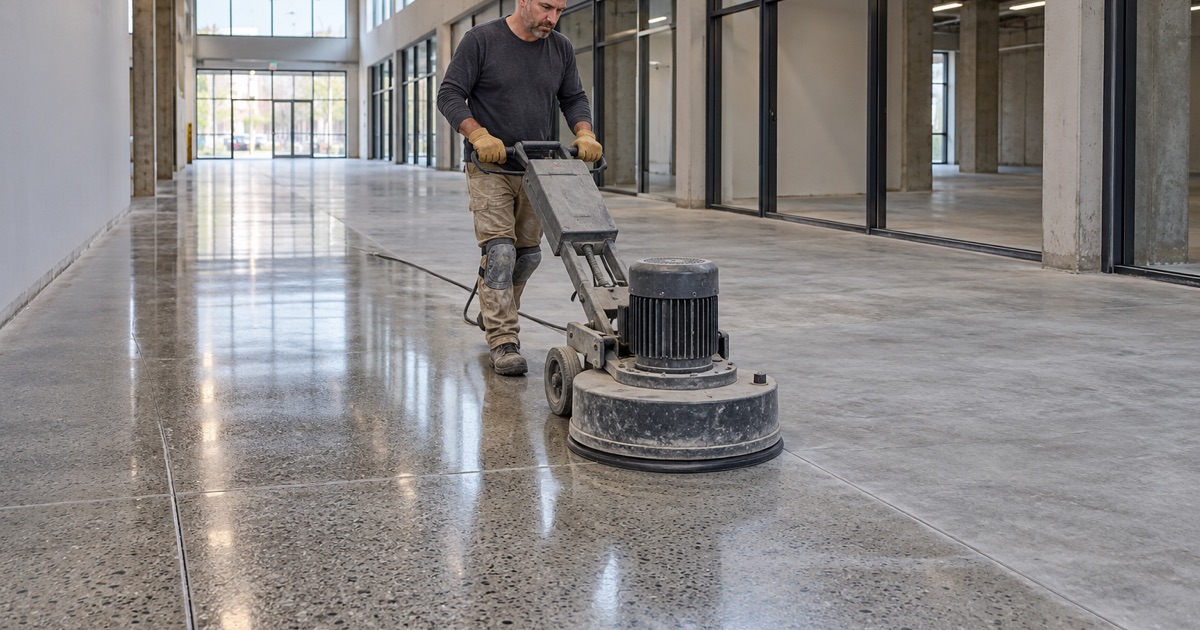
Polished concrete suits basements, office and retail spaces, food halls and shop floors where a hard, low-maintenance surface matters more than a decorative pattern. There is no film to peel, scratch through or recoat on a schedule, and the finished floor can be burnished back to its sheen for years.
Before we quote, we test-grind a patch of your slab. That small window shows what aggregate sits under the surface, how the concrete responds to the diamonds and which repairs will show, so the floor you approve is the floor you get.
Residential and Commercial Polished Concrete Floors
Basement and Living-Space Polished Floors
A polished basement slab gives a finished, easy-to-clean floor without a layer that moisture can push off. Because the surface is densified rather than sealed under a film, a basement with modest vapor movement can still be polished where a coating would be at risk. We still test the slab, since excess moisture can bring efflorescence to the surface.
Polished basements pair well with area rugs, radiant heat and modern finishes, and they hold up to the rolling weights of a home gym or a laundry room without denting.
Retail, Office and Food Hall Floors
Commercial polished concrete is popular in shops, offices, showrooms and food halls because it reflects light, takes heavy foot traffic and is quick to clean. Around the village, older office campuses are being converted to food halls and retail streets, and those floors often come up from under carpet or tile ready to grind. We schedule this work around opening hours, working in sections or overnight so the space keeps operating while the floor is finished.
Warehouse and Shop Floor Polishing
In light-industrial and warehouse spaces, a densified, polished slab resists dusting and the wear of forklift wheels and pallet jacks. It brightens a space without adding fixtures because the finished surface reflects overhead light back into the room. Joints are filled with semi-rigid filler to protect the edges from wheel impact. A polished warehouse floor needs no recoating cycle, which keeps maintenance shutdowns short.
How Concrete Is Polished
The Diamond Grit Sequence
Polishing runs through a series of diamond tooling, starting with coarse metal-bond diamonds that cut the surface open and flatten it, then moving through finer resin-bond diamonds that refine the scratch pattern step by step. Each pass removes the scratches left by the one before it, and skipping a step leaves swirl marks that show under light.
The number of passes depends on the condition of the slab and the sheen you want. A rough or uneven slab needs more cutting at the start.
Lithium Silicate Densifier
Partway through the sequence, we apply a lithium silicate densifier, which reacts with the concrete to harden the surface and reduce dusting. A denser surface takes a higher polish and resists wear better. Lithium silicate is our standard choice because it penetrates well and leaves minimal residue to clean up between passes.
Timing matters as much as the product. Applied too early, the densifier sits on a surface still full of open pores from the coarse cut; applied too late, the finer diamonds have nothing hard to refine. We apply it once the slab is flat and the scratch pattern is even, then let it react fully before the next pass.
Guards and Sheen Levels
After the final grit, a penetrating guard can be applied and burnished in to improve stain resistance and add a little sheen. You choose the final finish, from a low satin hone to a high-gloss reflection. Higher gloss shows more of the floor’s character and needs more steps, while a lower sheen hides wear and suits busier floors.
The guard is not a coating in the epoxy sense. It soaks into the top of the slab and can be reapplied when traffic dulls it.
Aggregate Exposure and the Slab You Have
Cream, Salt-and-Pepper and Exposed Aggregate
How deep the grind goes decides what the floor shows. A light grind keeps the cement cream on top for a smooth, uniform look. A slightly deeper grind reveals fine sand particles, called salt-and-pepper. Grinding deeper still exposes the larger stone aggregate, which creates a terrazzo-like surface.
You cannot choose aggregate that was never placed in the concrete, so the test grind tells us what is realistic for your slab. It also shows whether the stone is spread evenly or clustered in places, which changes how uniform an exposed-aggregate floor will look across a large room.
Cracks, Patches and Joints in a Polished Floor
Polished concrete shows everything in the slab, including cracks, patches and old adhesive stains. We fill cracks and joints with color-matched fillers, but they remain visible as part of the floor’s character. A slab with a lot of patchwork may suit a coating better, and we will tell you if that is the case.
Control joints get special attention because they carry the most wear. A semi-rigid polyurea filler, installed flush and ground with the floor, keeps cart wheels and forklift tires from chipping the joint edges, which is where an unprotected polished floor starts to break down first.
Dyed Polished Concrete
Penetrating dyes can be added during the polishing sequence to tint the concrete in grays, browns or deeper tones. Dye soaks into the densified surface rather than sitting on top, so it wears with the slab. Natural variation in the concrete still comes through, which gives a dyed floor its mottled, organic look.
We apply dye on a test section of your own slab before committing, because the same dye reads differently on a dense, troweled surface than on a porous, patched one. Saw-cut bands or borders can separate two colors where a lobby, a sales floor or a basement bar area needs its own zone.
When a Coating Is the Better Choice
Garages and Salt Exposure
A garage floor sees calcium chloride brine and rock salt every winter, and bare concrete absorbs that brine into its pores, where freeze-thaw cycles break the surface apart. A polished slab has no film to stop it. For garages, we recommend a coated system and keep polishing for interior floors.
The village rates weathering here as severe in its own building criteria, and a garage floor takes that exposure every time a car rolls in carrying slush. An epoxy base with a polyaspartic topcoat keeps the brine on top where it can be squeegeed away, which a densified slab simply cannot do on its own.
Slabs With Old Coatings or Heavy Damage
A slab that has had paint, sealer or adhesive soak deep into it, or one with extensive spalling and patching, will polish unevenly and show every flaw. Grinding it down may remove too much surface or still leave stains. In those cases, a coated floor over a properly ground slab gives a cleaner result.
Carpet and tile removals are the usual source of these surprises. Old mastic, thinset and tack strip holes come up with the flooring, and the test grind tells us whether the slab beneath is clean enough to polish or whether a decorative coating will serve the space better for the same budget.
Wet Kitchens and Washdown Areas
Commercial kitchens and washdown areas need a floor that meets food code cleanability expectations, includes coved bases and resists hot water and grease. Polished concrete does not cove up the wall and can be slick when wet with grease. We recommend urethane cement or a textured resin system for those spaces instead.
The dining room, corridor or retail side of the same building can still be polished, with a clean transition strip where the kitchen system ends. That split lets an owner put the budget where the floor works hardest while keeping the polished look in front of customers.
- 20+ Years Coating Concrete
- Moisture Testing in Every Scope
- Written Contract on Every Home Job