
Hoffman Estates Epoxy Flooring installs epoxy garage floors in Hoffman Estates, IL, serving surrounding cities including Barrington, Lake Zurich, Wood Dale, Prospect Heights and Cary. Over 20+ years we have learned that a garage coating succeeds or fails before the first bucket is opened, so every garage starts with a diamond grinder, a crack assessment and a moisture test.
The garage is the floor we coat most here. Nearly nine in ten houses in the village with a garage have an attached one, which means the garage slab sits against the living space, carries the family’s cars through a long salt season, and is often the first surface a visitor walks across. It deserves a coating system designed for that load, not a weekend kit.
What we install is written down before we start: the primer, the base coat, the broadcast, the topcoat and the finished thickness. You can measure the finished floor against the proposal, and so can we.
Garage Slabs in Hoffman Estates
Attached Garages From the 1960s and 1970s
More than half the housing here dates from 1960 to 1979, and those garages have had decades of salt, oil drips and patch jobs. Many carry an old sealer, a painted finish or a peeling store-bought coating that has to come off completely. We grind through all of it to sound concrete before any new resin goes down.
Older slabs also tend to show settled sections at the apron and a few hairline shrinkage cracks across the bays. Those are normal, and they get filled and ground flush so the new floor reads as one continuous surface.
No Vapor Retarder Under the Garage
The residential code the village adopted keeps the exception that allows a garage slab to be poured without a vapor retarder beneath it. That means moisture from the soil can move up through the concrete into a coating, whether the house is fifty years old or five. We screen every garage slab with a plastic sheet test and move to calcium chloride or relative humidity probes when the screen raises doubt.
A damp reading does not always rule out a coating. It does change the primer, and occasionally the schedule, and we would rather adjust both than watch a new floor blister in its first spring.
Cracks, Spalls and the Apron Joint
Before quoting we read every crack and spall on the slab and tell you which ones need repair before a coating can go down. Static cracks get a rigid epoxy or polyurea filler, while the joint between the garage slab and the driveway apron is treated as a moving joint and kept flexible. A coating follows whatever the slab does under it, so we never promise it will stop movement. Spalled areas near the door, where salt and freeze-thaw have broken the surface away, are cut back to sound concrete and rebuilt with a repair mortar before grinding.
Garage Floor Coating Systems
Flake Over a 100% Solids Epoxy Base
Our most requested garage system is a 100% solids epoxy base with a full broadcast of vinyl flake, scraped and sealed under a clear topcoat. Solids content matters because a water-based or solvent-thinned product shrinks as it dries, leaving a thinner film than was applied. A 100% solids base keeps the thickness we specify.
The full broadcast hides tire marks, dust and the small imperfections every garage slab has, and the chip blend lets you match the house trim or the cabinetry on the wall.
Polyaspartic Garage Coatings
A polyaspartic or polyurea system cures much faster than epoxy and holds its color in sunlight, which matters on a garage that faces the street with the door open. It also tolerates a wider temperature range during application. We use it as a topcoat over epoxy on most floors and as a full system where the schedule calls for it.
Fast cure has a trade-off: a shorter working window and less forgiveness on a poorly prepared slab. That is one more reason the grinding step is never skipped.
Solid Color and Quartz Garage Floors
A solid gray or tan coating suits a workshop garage where tools and parts get dropped and searched for. Quartz broadcast adds a harder, grittier texture that grips better with snowmelt on it. Both are built on the same ground surface and moisture test as a flake floor.
Salt, Tires and Cure Windows
Built to Resist Calcium Chloride and Rock Salt
The brine sprayed on the roads and the rock salt that falls off wheel wells soak into bare concrete and break it down with every freeze. The village’s own building criteria rate weathering here as severe, with a 42-inch frost line. We choose topcoats for chemical resistance to those deicers and seal the floor edge to edge so brine sits on the surface until it is squeegeed out.
Stopping Hot Tire Pickup
Tires warmed on the tollway soften a thin coating, and when the car cools in place the coating bonds to the rubber and lifts. A properly profiled surface, a full-thickness base and a hard topcoat resist that pull. Most cases of hot tire pickup we are called to repair trace back to an acid-etched slab under a thin, water-based coat.
Scheduling Around Slab Temperature and Dew Point
We read the slab temperature and the dew point spread at the surface before we coat, because a cold or damp surface slows the cure and can leave amine blush on epoxy. An attached garage borrowing heat from the house can usually be coated through the winter. A cold, unheated detached garage often has to wait for spring, and we say so.
Our Step-by-Step Epoxy Garage Floor Process
Step 1: Slab Walk-Through and Moisture Screen
We inspect the floor, the old coating or sealer, every crack and the drain, and tape down a plastic sheet moisture screen where the slab looks most suspect. The proposal follows, naming the products, the build thickness, the repairs and the schedule, along with the written contract and the consumer-rights pamphlet Illinois requires for home repair work.
If the moisture screen raises a question, we come back with calcium chloride kits or relative humidity probes before the job is booked, so the primer choice rests on a number rather than a guess.
Step 2: Diamond Grinding and Repairs
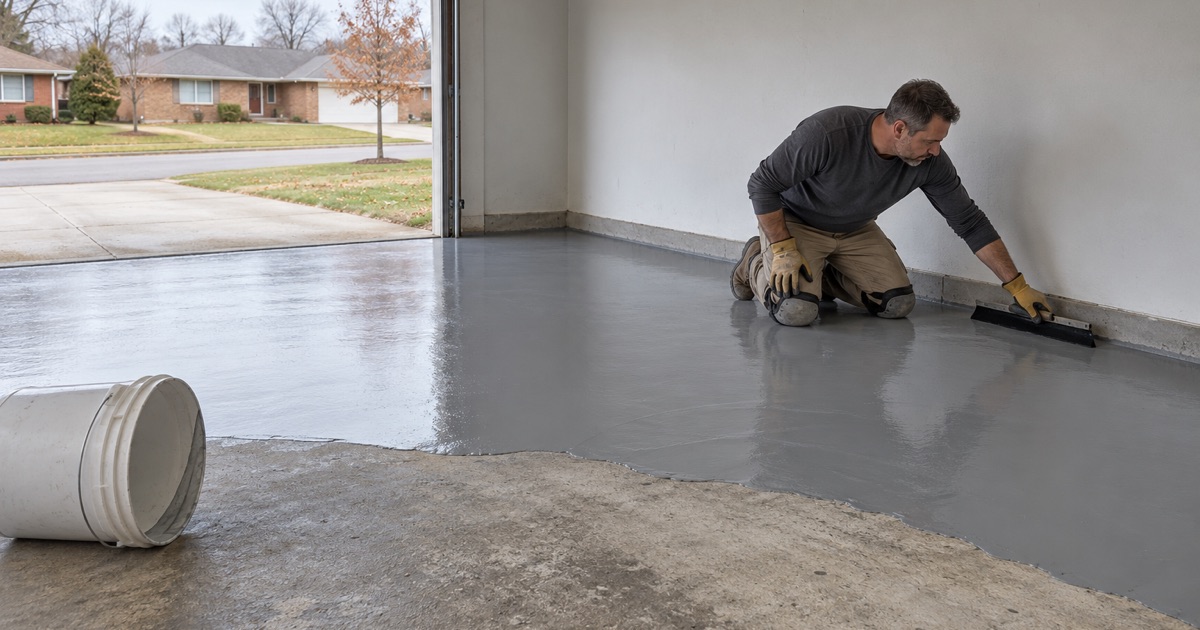
The slab is ground edge to edge with a planetary diamond grinder, hand grinders reaching the corners and the strip along the walls, with HEPA dust extraction running the whole time. We grind to the surface profile the system calls for, then fill cracks, rebuild spalls and treat the apron joint before grinding the repairs flush.
This is the longest part of most jobs, and it is the step a low bid usually leaves out, because acid and a scrub brush take an hour while grinding takes most of a day.
Step 3: Primer and Base Coat
The primer or moisture-mitigation layer goes down first and soaks into the open concrete, followed by the 100% solids epoxy base, rolled out to the thickness the proposal names. We work the base in sections so every edge stays wet and the floor cures as one continuous film, without lap lines.
Step 4: Broadcast and Scrape
Flake or quartz is broadcast into the wet base until it covers the resin completely. Once the base has cured, we scrape the floor to knock down any standing chips and vacuum up the loose media, so the topcoat lays over a clean, even texture with no sharp edges underfoot.
Step 5: Topcoat and Cure Schedule
The clear topcoat seals the broadcast and carries the wear, salt and tire resistance of the system. We leave you a written schedule for foot traffic, vehicles and the first cleaning, set against the slab temperature readings taken that day, plus simple care notes for squeegeeing out winter brine.
- 20+ Years Coating Concrete
- Moisture Testing in Every Scope
- Written Contract on Every Home Job