
Hoffman Estates Epoxy Flooring provides concrete grinding in Hoffman Estates, IL, serving surrounding cities including Barrington, Lake Zurich, Wood Dale, Prospect Heights and Cary. Grinding is the first step of every floor we coat and the part of the job that decides whether a coating holds, so after 20+ years we treat it as a trade of its own rather than a quick pass before the real work.
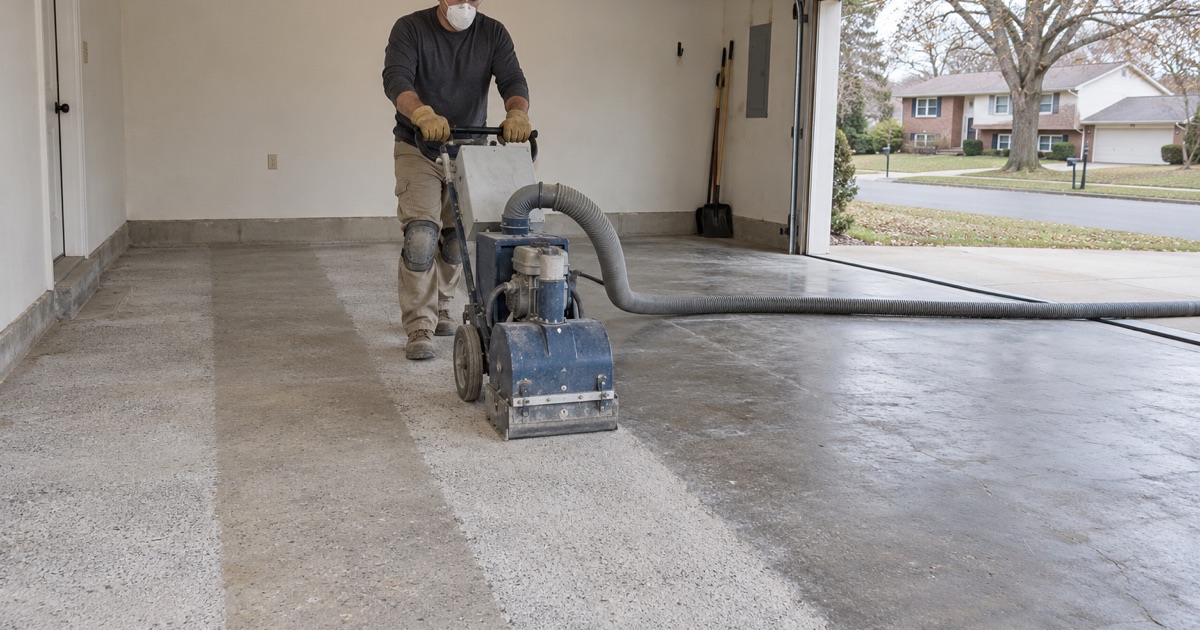
Concrete grinding uses rotating diamond tooling to cut away the weak top surface of a slab, along with paint, sealers, adhesives and old coatings. What remains is clean, porous, sound concrete with a texture that primers and coatings can lock into. The same equipment, with finer tooling, is what polishes concrete when no coating is going down at all.
We grind garages, basements, commercial floors and kitchens, and we also take on grinding work for owners who simply need a failed coating gone, a trip edge flattened or carpet glue removed. In every case the scope names the tooling, the profile we are cutting and how dust will be controlled.
Grinding Versus Acid Etching
Acid etching is the method in most store-bought garage kits: a diluted acid is poured on the floor, scrubbed and rinsed. It dissolves a thin skin of cement paste, but it does not remove sealers, oil or the weak laitance on many slabs, and it leaves an uneven profile that changes from one part of the floor to the next. Residue left in the pores can interfere with bond even after rinsing.
Diamond grinding removes that weak top layer mechanically and leaves a consistent texture that can be checked against the ICRI concrete surface profile scale. That consistency is the reason we do not acid etch any floor. Most of the peeling garage coatings we are called to remove were applied over an etched surface, and the failure lines up with the weak layer the acid never took away.
Surface Profiles and Matching the System
The ICRI CSP scale runs from 1, nearly flat, to 10, a very rough and heavily textured surface. A thin sealer or polyaspartic topcoat system wants a lighter profile, while a thick epoxy build, a moisture-mitigation primer or a urethane cement system needs a deeper one to anchor into. Cutting too shallow risks a weak bond, and cutting too deep wastes material filling the texture back in.
We choose tooling grit and bond to hit the profile each product’s data sheet calls for, then check the finished surface against profile reference chips. On a slab with a hard, troweled surface the coarse metal-bond diamonds do most of the work, while a softer slab may reach the profile with a less aggressive pass.
Concrete Grinding Methods and Tooling
Removing Old Coatings, Sealers and Adhesives
A new coating can only grip as well as the layer beneath it, so any old paint, epoxy, sealer or adhesive that is not removed becomes the weak link. Thin films and sealers come off with standard diamond tooling. Thick epoxy, elastomeric coatings and some mastics gum up diamonds, so we may start with carbide tooling or a ride-on scraper before the diamonds finish the surface.
Carpet and tile removals often leave adhesive residue and thinset, especially in older office and retail spaces. Grinding takes that residue down to clean concrete and tells us how the slab will look if it is going to be polished or coated next.
Shot Blasting for Large and Commercial Floors
Shot blasting propels steel shot at the concrete and vacuums it back up, leaving an even, open texture over large areas quickly. It suits warehouses, distribution floors and other wide open spaces where a deeper profile is needed for a heavy epoxy or urethane system. It is less precise at edges and corners, so we pair it with hand grinders around walls, columns and drains.
For residential garages and basements, a planetary diamond grinder usually gives better control and a cleaner finish. We choose between the two based on the floor area, the system going down and the access to the space.
Dust Control and Flatness
Grinding concrete releases fine dust, including crystalline silica, so every grinder we run is connected to a HEPA dust extractor. We seal doorways to living space or occupied areas with plastic and keep the extraction running through the whole job. That control matters even more in a basement, where dust would otherwise drift up the stairway into the house.
Grinding also improves flatness. High spots at slab joints, ridges from old patches and lipping at cracks are taken down so the finished floor reads as one even surface, and trip hazards at transitions are removed. That is especially important under metallic epoxy and polished concrete, which show every dip and ridge beneath them.
Grinding Before Moisture Testing and Repairs
Grinding comes before the final moisture readings and the crack repairs for a reason. A sealer, a curing compound or an old coating can hold moisture down in the slab and make a plastic sheet test read drier than the concrete really is. Once the surface is open, the slab breathes the way it will under a new coating, and the calcium chloride or relative humidity numbers we take reflect what the primer will actually face.
The same goes for cracks. A grinder exposes hairline cracks hidden under paint or a glossy sealer and shows which patches from years past are loose. We would rather find a hollow patch at this stage, where it can be cut out and rebuilt, than have it lift under a finished floor because it was coated over.
Concrete Grinding for Polishing and Densifying
When no coating is going down, grinding becomes the floor itself. The first metal-bond passes flatten the slab and set how much aggregate will show, from a cream finish with almost none to a fully exposed stone surface. A lithium silicate densifier goes in partway through to harden the concrete, and finer resin-bond tooling takes the surface to the sheen the owner chooses.
A ground-and-sealed floor is the simpler cousin of polished concrete: the slab is ground to an even texture, densified and finished with a penetrating sealer rather than refined to a high sheen. It suits utility rooms, storage areas and light-commercial back rooms where a clean, dust-free surface matters more than a reflective one, at a lower cost than a full polish.
- 20+ Years Coating Concrete
- Moisture Testing in Every Scope
- Written Contract on Every Home Job